-
-
Things I learnt at CSS Dev Conf
Jank
This is the word Paul Irish (@paul_irish) used to describe that jittering, stuttering effect that happens when you aren't syncing your animations with the monitor using requestAnimationFrame. Find out more about Jank at jankfree.com or requestAnimationFrame at CreativeJS.
SuperToonists
Rachel Nabors (@CrowChick) and Kyle Weems (@cssquirrel) are just as cool in real life as they are on the Twitter. Probably moreso, in fact, as there's more than 140 characters of them at a time.
Scoped Revelation
Tab Atkins (@tabatkins) explained over the buffet table the reason why the spec went for
<style scoped></style>rather than
<scopedstyle></scopedstyle>It had been bugging me that using the former meant that this wasn't backwards compatible but it turns out I was totally wrong on this one. By using the attribute rather than a new tag, the styles were backwards compatible. They would still be interpreted by older browsers (although they would still spread out to affect the whole page). If they had been included in a new tag, older browsers wouldn't have read them. The affect of the styles on the page can be avoided by introducing an ID inside the block to be scoped (and all styles within the scoped block). That way, older browsers can continue to work fine while newer browsers that interpret the attribute correctly will benefit from the improved performance of having styles only affecting a small chunk of the page.
This is why I don't write specs.
Choose your elements wisely
The examples for improving selector performance for GitHub's diff pages presented in Jon Rohan's talk made me wonder "Do I really need all these divs?". Read more yourself. Also, I love the word 'Design-gineer'.
A Porter?
Pam Selle (@pamasaur) couldn't believe I had never heard of a porter beer. Is this actually a thing? Wikipedia seems to think so but then, Wikipedia can be convinced that Julianne Moore is Dudley Moore's daughter so I'll need more proof than that. Ale, stout, bitter, lager, all words I'm familiar with but 'porter'? Nope.
More than you'd think
I thought I had a fairly comprehensive list of all the CSS testing tools out there. Really. I've spent over a year researching and testing as many as I could get my hands on. There are even more. Phil Walton (@philwalton) made some excellent points around mocking content for tests that I'm going to have to follow up on.
Skyscraper
Christopher Schmitt (@teleject) is tall. Really tall. No, taller than that.
-
CSS Dev Conf
Last week I was at CSS Dev Conf in Hawaii - the first of an annual series of conferences. Not only was I there, I actually gave a talk!
I gave an overview of the tools and techniques available for automated CSS testing. I didn't mention it much here or on twitter because, well, I was kinda nervous and didn't want to jinx it. In my daily job, I organise Tech Talks and give pointers to people on how to make their presentations exciting and full of awsm but I tend to avoid actually standing up at the front of the room myself. Beyond introducing the speakers, that is. This is probably why I used to help organise gigs more than play them.
I won't repeat the content of the talk here. For that, you should start out by checking out the slides. The main point I finished on, however, is that the web dev community has fantastic tools for testing every aspect of web development except CSS and that it appears that every developer interested in the subject has started from scratch and built a tool that does what they need it to do. I'm hoping that I can turn http://csste.st/ into a community-driven site where people can share best-practices, techniques, tools and terminology around CSS testing. That way, we can create some sturdy processes around testing our CSS and not reinvent the wheel every few months.
The conference
Firstly, the trip to Hawaii: it was fantastic. I spent the weekend before the conference staying in a backpackers hostel on Waikiki beach. If you ever need somewhere to stay for a fraction of the price of a hotel on Waikiki, I totally recommend the 'Waikiki Backpackers Hostel'. Backpackers' hostels are the same everywhere - there are the people who hang around reception that may or may not work there, you can't quite tell; there's the Australian guy who comes down drunk for breakfast, smokes half-a-dozen cigarettes quickly then goes back to bed until the afternoon; there's the guy in his mid 70s who looks like a cross between everybody's favourite grandad and a stereotypical acid-casualty.
I swam with turtles in Hanauma Bay, climbed up Diamonhead Ridge, took a bus to the far side of downtown then spent 4 hours walking back via Iolani Palace. Like I say, it was a fantastic trip, even for someone who doesn't like the sun that much.
On the Tuesday, I moved into the Outrigger Reef on the Beach hotel for the conference. Ooh, posh. I could practically step out of my room into the elevator then step out of the elevator onto the beach. I then got to spend my remaining time in Hawaii hanging out with a huge bunch of cool, clever people (Rachel Nabors put together a Twitter list of the speakers), all of whom know an awful lot about web development.
With any multi-track conference there are always going to be a few sessions you have to miss but with CSS Dev Conf being four-track and having such a high level of quality, I kinda worry that I missed out on about three-quarters of what I wanted to see. Fortunately, everybody's been sharing their slides so I can at least get the gist of what they were talking about.
The journey
All in all, I'd totally recommend keeping an eye open for the announcement of next year's CSS Dev Conf. It might not be held in Honolulu again but, from my point of view, that's a good thing. It really is a fantastic place to spend time (seriously: turtles!) but getting there from Berlin is not the easiest thing. In fact, if you use the 'Earth Sandwich' lab on here.com, you can see how close Hawaii is to being the Exact Opposite Side of the World from Berlin. On the way out there, it didn't seem too bad as I left on Friday morning (Berlin time) and landed on Friday evening (Hawaii time) but on the way back, I left on Thursday and landed on Saturday. That was quite a journey.
-
jHERE playground
Every couple of months, we have a Research Week. It's kind of like the well-known Google 20% time but instead of doing it one day a week, we gather up our time and do a week of maps-based hacking. It's totally cross-discipline so we usually gather a couple of developers, a couple of UX and visual designers, a QA and build something cool. In past Research Weeks, I've built or helped build the Alien Easter Egg, Maps Labs and CoverMap.Me. I also built a maps-based JSBin fork called JotApp.
When my partner-in-crime Max started working on the latest version of his jQuery plugin (formerly called jOvi, now called jHERE), I wanted to build a new playground where people could play and build their own maps mashups and hacks really easily. My first thought was to rework the fork of JSBin again and maybe add in a slightly nicer default theme. I wanted users to be able to save to Gists so, seeing as there is already an SQLite and a MySQL adapter, I wrote a Gist adapter which appeared to the application as if it were a database but actually saved to anonymous Gists. The problem was that it was a bit too… heavy.
Don't get me wrong, JSBin is a fantastic project. It just does a lot more than I needed. I didn't need the MySQL adapter, the alternate themes, the localstorage or the user registration. Also, it's a bit too weighty for my phone. When someone tweets a link to a JSBin or a JSFiddle, I usually check it out on my phone and it's not the best experience. Seeing as HERE maps work on mobile, I wanted my playground to work, too. Rather than spend a couple of hours cutting out all the bits I didn't want from JSBin, I decided to spend a couple of hours building my own version from scratch. So, this past Sunday afternoon, that's exactly what I did:
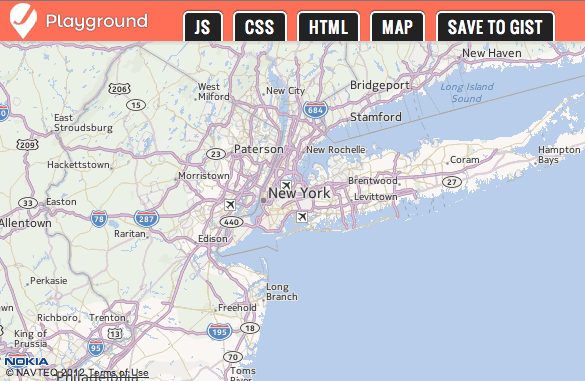
It's written in NodeJS on top of express and works nicely on desktop, iPad and mobile.
The project is open-sourced on GitHub (naturally) and can be modified to be a general JS-playground for anything. If you fancy a simple, self-hosted JS hackspace, just change the default HTML, CSS and JS and it's ready to go.
-
Open Source Snacks
In my opinion, seed snacks are pretty much the perfect web dev snack: they're tasty, they're low-fat, they're vegan-friendly, they're gluten-free. I've always got a tub of some next to my monitor so, when I'm chewing over a tricky layout, I can grab a handful and chew them, too.
This repository collects some of my favourite seed recipes and I'm hoping that other web devs can clone the project, roast their own, suggest improvements and submit a pull request. If you have any other easy to make snacks (such as nut snack recipes), feel free to submit them, too.
Eating tips
From observation, seed eaters tend to fall into one of these categories:
Pour-and-snarf

Pour a few into your hand, tip them into your mouth in a oner. Good when you're in a hurry. Can lead to stray seeds falling into the keyboard.
Considerate Ant-eater

Pour a few into your hand, stick your tongue into the pile of seeds, retract.
Solo Ant-eater

Stick your tongue directly into the tub of seeds. Clean, efficient, not good for sharing.
Ice-cream scoop

Use a spoon. Good for sharing and minimises mess. Prevents multi-tasking. Feels kind of like using your mouse to go Edit > Copy when ctrl-C is right there.
Rousing call-to-arms
The stereotypical image of the geek - bottle of cola on one side, jumbo bag of chips on the other, little desire to do anything beyond the computer - has never really been true for the majority. We're all kinds of different people - mountain climbers, cyclists, needlepoint workers, knitters. The people that played on the football team and the ones who didn't get picked. We deserve more than just nachos.
Also nachos.